Shatranj.ai presents a heritage-first, build-and-experiment model of AI in education. We use chess, shatranj, and historical board games to help students understand artificial intelligence from the inside: rules, states, search, evaluation, learning, ethics, and intelligent system design.
Our goal is not only AI literacy in the sense of awareness or tool use. Our goal is to help young people become future AI architects: learners who can explain, build, test, improve, and responsibly question intelligent systems.
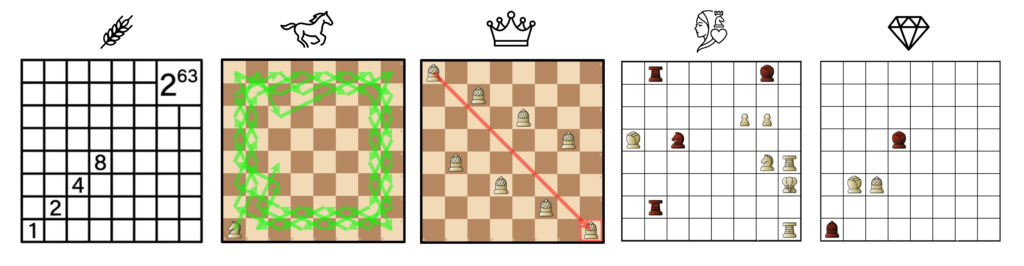
The Shatranj.ai curriculum begins with ancient chessboard challenges and turns them into modern lessons in computation, algorithms, and artificial intelligence.
Artificial intelligence in education should not be reduced to using chatbots, writing prompts, or automating homework. Students also need to understand how AI systems represent problems, search possibilities, evaluate choices, learn from feedback, and affect society.
Shatranj.ai gives institutions a concrete way to teach these ideas. A board game is a visible system: every position has a state, every move changes the state, every rule can be coded, and every algorithm can be inspected, debugged, compared, and improved.
The intertwined history of chess and artificial intelligence is central to our teaching philosophy. From early automata and café chess culture to Shannon, Turing, Deep Blue, Stockfish, AlphaZero, and modern learning systems, chess gives students one of the clearest historical pathways for understanding how humans imagined, built, tested, and improved intelligent machines.
Shatranj.ai is an Erasmus+ KA2 youth education project built around the idea that artificial intelligence becomes easier to understand when students can see it through games, puzzles, history, and code.
We combine cultural heritage with computational thinking. Students explore historic board games from European, Mediterranean, African, Asian, and Islamic intellectual traditions, then rebuild these games as programmable systems.
This approach makes AI education more inclusive. Students do not begin with abstract machine-learning terminology alone. They begin with familiar ideas: boards, pieces, rules, moves, puzzles, strategy, stories, and decisions.
Our educational promise is simple: students move from playing games to modeling systems, from solving puzzles to implementing algorithms, and from using AI tools to thinking like future AI architects.
Historic board games are powerful educational laboratories. They are culturally meaningful, visually clear, mathematically structured, and computationally rich. They allow students to connect history, language, design, ethics, mathematics, computer science, and artificial intelligence.
In Shatranj.ai, students work with chess, shatranj, Qirkat, Mancala, the Royal Game of Ur, 3-stone and 9-stone games, Othello/Reversi, checkers variants, and other strategic games. The point is not to teach AI as a single technique. The point is to teach AI as a transferable way of representing and solving problems.
Shatranj.ai teaches AI through algorithms that students can see, test, debug, and explain. The curriculum starts from board representation and legal move generation, then moves toward search, evaluation, dynamic programming, reinforcement learning, and AlphaZero-style self-play.
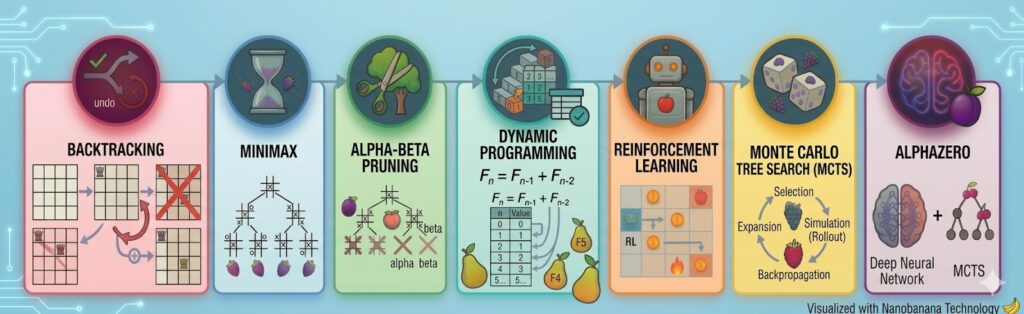
Shatranj.ai teaches AI algorithms as a developmental pathway: from puzzles and search to reinforcement learning, Monte Carlo Tree Search, and AlphaZero-style systems.
Students learn how to represent boards, pieces, legal moves, game states, terminal conditions, and evaluation features. This is the foundation of every game engine and every explainable AI activity in the curriculum.
Students study depth-first search, breadth-first search, uniform cost search, heuristic search, and A*. These algorithms help learners understand state spaces, paths, costs, heuristics, and systematic exploration.
Students implement minimax, expectiminimax, evaluation functions, and alpha-beta pruning. They learn how chess engines compare candidate moves and how pruning makes deep search more efficient.
Puzzles such as the Horse Tour and Eight Queens make backtracking visible. Students learn how an algorithm tries a choice, detects failure, returns, and explores alternatives.
Suli’s Diamond becomes a lesson in dynamic programming, state spaces, stored results, tablebase-style reasoning, and the relationship between historical puzzles and modern computation.
Students connect board-game decisions to rewards, value updates, Q-learning, temporal-difference learning, deep Q-networks, Monte Carlo rollouts, MCTS, and AlphaZero-style self-play.
The algorithm sequence includes board representation, move generation, backtracking, DFS, BFS, Uniform Cost Search, A*, minimax, expectiminimax, alpha-beta pruning, dynamic programming, reinforcement learning, Q-learning, deep Q-networks, Monte Carlo rollouts, Monte Carlo Tree Search, PUCT, policy/value networks, and AlphaZero-style pipelines.
These algorithms are not taught as isolated computer science theory. They are taught through the cultural and intellectual history of games: ancient puzzles, medieval shatranj, manuscript positions, modern chess engines, and contemporary AI systems.
The Shatranj.ai curriculum is designed as a buildable pathway. Students begin with computing foundations and Python, then move into board-game modeling, search algorithms, AI game engines, reinforcement learning, and AlphaZero-style learning systems.
Explore the Shatranj.ai curriculum • Visit the Shatranj.ai learning platform
Chess has been one of the most important public laboratories in the history of artificial intelligence. It helped researchers ask fundamental questions: Can machines reason? Can they search possible futures? Can they evaluate positions? Can they learn without being explicitly told what to do?
Shatranj.ai uses this history as an educational spine. Students encounter the story of chess and AI not as a list of famous machines, but as a sequence of ideas: representation, search, evaluation, optimization, learning, hardware constraints, explainability, and human-machine collaboration.
This historical approach helps institutions teach AI as a human story: a story of ideas, cultures, tools, limits, experiments, and ethical choices.
The flagship public talk for this educational philosophy is the TEDxBoston talk: Chess: Bridging Cultures, Inspiring AI, and Redefining Education.
This talk connects chess education, cultural heritage, inclusive design, historical chess pieces, ancient puzzles, and the deep relationship between chess and artificial intelligence.
Watch the Shatranj.ai extended edit • Watch the TEDxBoston version • See all Shatranj.ai talks
AI in education should not be limited to coding alone. The Shatranj.ai model connects artificial intelligence with history, art, philosophy, language, literature, economics, ethics, cultural heritage, mathematics, computer science, and social sciences.
Students study how chess, shatranj, and related games traveled across civilizations, languages, manuscripts, and visual traditions.
The board becomes a laboratory for coordinates, counting, geometry, combinatorics, exponential growth, search, and optimization.
Students discuss fairness, explainability, responsible use, environmental costs, human judgment, and the social impact of AI systems.
This multidisciplinary approach makes AI more accessible to students who may enter through different strengths: logic, art, language, history, gaming, design, mathematics, storytelling, or social questions.
Shatranj.ai treats AI ethics as part of the core curriculum, not as an afterthought. Students should understand not only what AI can do, but also what it costs, where it fails, who it affects, and how it should be governed.
Our AI-in-education model can support classroom discussion around:
Shatranj.ai gives institutions a practical model for AI education that is culturally rich, technically meaningful, and adaptable to different settings.
The program can support:
This approach is especially useful for institutions that want AI education to be understandable, ethical, hands-on, culturally inclusive, and connected to measurable learning outcomes.
Shatranj.ai is part of a wider ecosystem that connects curriculum, school implementation, cultural heritage, nonprofit outreach, and public communication.
A build-and-experiment AI pathway based on chess, shatranj, historical board games, Python, AI algorithms, and modern chess software.
A historical shatranj endgame study used to teach dynamic programming, tablebases, state spaces, verification, and the preservation of intellectual heritage.
A school-friendly cultural heritage exhibit connecting chess sets, manuscripts, historical pieces, inclusion, visual culture, and educational storytelling.
An early-childhood and primary-school chess curriculum foundation connected to compulsory school chess, classroom routines, social-emotional learning, and multilingual chess learning.
Institutions need more than inspiration. They need clear learning outcomes, teacher support, reusable materials, and a pathway that can be adapted for different ages and settings.
The Shatranj.ai AI-in-education model can support outcomes such as:
We welcome conversations with schools, ministries, universities, foundations, nonprofits, municipalities, chess federations, cultural institutions, and education leaders interested in implementing AI education through chess and historical board games.
Shatranj.ai teaches AI through chess, shatranj, and historical board games. Students learn how intelligent systems represent states, generate moves, search possibilities, evaluate choices, learn from feedback, and improve over time.
No. AI literacy is part of the pathway, but the larger goal is to help students become future AI architects. They learn not only what AI is, but how AI systems are built, tested, explained, and improved.
The curriculum introduces board representation, legal move generation, backtracking, DFS, BFS, Uniform Cost Search, A*, minimax, expectiminimax, alpha-beta pruning, dynamic programming, reinforcement learning, Q-learning, deep Q-networks, Monte Carlo rollouts, Monte Carlo Tree Search, PUCT, and AlphaZero-style self-play.
Board games make AI visible. Every position has a state, every move changes the state, every rule can be coded, and every algorithm can be inspected. Historical board games also connect AI education to culture, heritage, design, and human decision-making.
No. Students do not need to be strong chess players. The games are used as learning environments for logic, programming, algorithms, culture, ethics, and AI concepts.
Yes. Schools can use Shatranj.ai as a modular AI pathway for electives, clubs, STEAM programs, coding bootcamps, interdisciplinary projects, teacher-training programs, and youth innovation activities.
Students discuss explainability, fairness, human judgment, responsible automation, and the environmental impact of AI computation. The goal is to build technical understanding together with ethical responsibility.
The page gives institutions a clear model for AI education: a culturally inclusive curriculum, a sequence of teachable algorithms, practical school implementation paths, ethical framing, and links to curriculum, talks, learning materials, and project outputs.